Tag Archives

3 Articles
No Depression-Era concern Went Under quite like Dugmar Golf Club

No Depression-Era concern Went Under quite like Dugmar Golf Club

Lost Golf Courses
Ed. — This story first appeared in March/April 2003 issue Golf Journal magazine.

By HAL PHILLIPS
The Swift River started rising
in the rural Massachusetts town of Greenwich on Aug. 14, 1939. Soon enough the fairways at Dugmar Golf Club had become unseasonably soggy. After a time the bunkers and teeing grounds were completely submerged. Had the pins not been removed years before, their flags would have been some of the last things visible before this 9-hole track and the rest of Greenwich were lost for good.

It’s been 68 years since Greenwich and three neighboring bergs were systematically condemned and flooded, all in the name of Metropolitan Boston’s chronic thirst. This massive, Depression-Era public works project, on whose ass the loss of Dugmar GC was but a pimple, created the Quabbin Reservoir, then the largest man-made, fresh-water reserve on earth.

The Lost Towns, as they’re known today, were literally erased by the Quabbin’s introduction; every tree, every man-made structure in the Swift River Valley was burned or bulldozed to make way for it. The river itself having been dammed — in Belchertown, to the south — some 412 billion gallons of water gradually rose behind the Winsor Dam and Goodnough Dike. Not until 1946 did they first lap over the reservoir’s massive spillways.

By then Dugmar GC had been largely forgotten — but not erased, for memories are made of stronger stuff.

Dugmar Golf Club: The First Disposable Course

Other layouts have been lost to history, of course. Some have simply been abandoned; others were sold off to make way for post-war suburbia. But so far as we know, Dugmar GC — opened for play in 1928, hard by Curtis Hill — was the only golf course to meet its end in a purposeful deluge, sacrificed along with four 200-year-old communities to supply tens of millions of faucets in larger communities some 60 miles east.

Hundreds of golf clubs were built, as Dugmar had been, during the heroic age of Jones and Ruth, when the moneyed classes sought to bring the same sort of bravado to their own lives (not to mention a place to drink hooch in a country gone dry). More than a few of these establishments “went under” during the ensuing Depression, but none quite so purposely or literally as Dugmar Golf Club. You see, Dugmar’s developers KNEW the club’s fate before the course was ever built — before the bentgrass was imported from southern Germany, before the elegant stone patio was laid beside the farmhouse-turned-clubhouse, before the first crate of Canadian Club was hidden from view.

Dugmars creation was, in short, a set up: a crafty land deal with golf at its core; a trifle built to amuse its backers, for a time, before enriching them at the public’s expense. “Those guys knew what they were doing; they made out,” recalls a chuckling, 85-year-old Stanley Mega, who caddied at Dugmar GC and still lives close by Quabbin’s shores, in Bondsville. “Those guys knew the reservoir was going in and they made a killing.”

In essence, Dugmar GC was conceived and ultimately proved to be the world’s first and only disposable golf course.

Lost Golf Courses
This aerial of Dugmar GC was taken in 1931

Canny Chapman Valve Co. Executives

“Those guys,” the men behind Dugmar Golf Club, were a pair of canny executives from the Chapman Valve Co. in Springfield, then and still today the hub of Western Massachusetts. In 1924, Chapman President Thomas F. Mahar and Treasurer John J. Duggan together purchased a pleasant chunk of property some 30 miles northeast of their corporate offices — in the tiny hamlet of Greenwich (pronounced green-witch), conveniently located on the Athol branch of the Boston-Albany Railroad.

The towns of Greenwich, Dana, Enfield and Prescott were poor farming communities and had been for centuries, but their lakes and myriad points of river access were popular with holiday-makers from the big city. It was common for Springfielders to own summer camps and cottages up there.

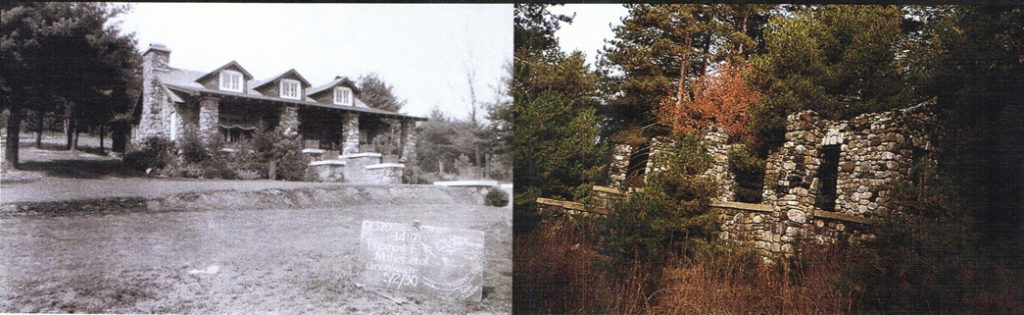
Duggan and Mahar had far grander plans. After paying $6,850 for 147 acres of abandoned agricultural land, they immediately set to work refurbishing the property’s existing farmhouse. In 1925 its value was assessed at $2,000; two years later this homestead was valued at $7,000. Next, Duggan and Mahar built a striking fieldstone lodge on the south-facing slope of Curtis Hill. Completed in 1926, it was assessed a year later at $12,000.

Once an additional 15 acres had been purchased, they commissioned Orrin Smith to design and build Dugmar’s golf course. Opened in 1928, the nine-hole layout occupied ground southeast of Curtis Hill, in full and magnificent view of the lodge with its distinctive stone-pillared porch.

The layout at Dugmar — a moniker created by combining the surnames Duggan and Mahar — was not some bit of amateur course design. Smith had been a respected and quite prolific New England architect, one who had apprenticed with Willie Park Jr. and Donald Ross before starting his own Hartford, Conn.-based practice in 1925. Dugmar GC measured a stout 3,160 yards from the back tees, boasted state-of-the-art putting surfaces of South German bentgrass, and featured 8,000 feet of underground irrigation pipe, something only the better courses could afford in those days.

An unforgettable place

“It was an unbelievably beautiful place right there in the valley. I’ll never forget it,” says Mega. “It was a very nice golf course, but I was too young to play back then. We caddied. I used to travel up there with Dave Belisle and Jimmy Fitzgerald. We spent a lot of time up there. If I made 35 cents a round, well, that was great!”

Mega and his older brother Alec would often rise in Bondsville, their tiny home town just south and west of the Swift River Valley, and take the train up to Greenwich. Or they’d hitch a ride via Belchertown on Route 21, the only paved road that ran north/south through the watershed. “It was quite a place up there. A few of the holes I forget, but I remember everything else. Between the 1st and 2nd there was a big stand of pine, sort of squared off. There were more woodlands guarding the 3rd, on the right. That’s where I found all my golf balls, you know. Now that was a nice hole, a great dogleg par-5.

“The greens were what always impressed me,” Mega continues, gathering steam. “Tiny things. You had to be accurate! And boy were they in great shape. Beautiful. Imported! People were always bragging about how they were imported. In fact, before they flooded the place, someone came in, picked up those greens and took them away! … I just caddied up there but my brother, he was a good golfer. He played Dugmar quite a bit. So did another good player, Whitey Wisnewski, who was almost like a pro. He used to play with [Henry] Bontempo here in Springfield. He played the best around. Good golfers played up at Dugmar. I still remember.”

A Raucous Close to Phase I

The 1928 opening of Dugmar’s 9-hole course fulfilled the “Phase I” vision of its founders. This was now a fully fledged country club, complete with a golf course ana clubhouse. It featured several guest rooms and a lively social calendar — because, lest we forget, this was the decade of Prohibition.

“There were raucous parties up there; they certainly took advantage of the remoteness of the place,” explains J.R. Greene, an historian who’s been researching Quabbin and the Lost Towns since 1975.

“The Greenwich Village train stop was very close to the golf course, a short walk. So it was very convenient for these ‘bit city outlanders’ to travel there from Springfield. And I have it on very good authority that Dugmar members brought plenty of liquor up there — and women who weren’t necessarily their wives. This was a heavily Yankee, Protestant region; there were no bars or taverns there, even before Prohibition. So that sort of behavior was duly noted.”

“It was a wild place,” Mega concurs. “To be served drinks, well, you had to know the right people. There was a lot of drinking. Those guys were really something; they knew what they were doing.”
Curtis Island
The fieldstone lodge serving Dugmar used to sit on Curtis Hill. Today, it’s Curtis Island.

Phase II? Depends on Whom You Ask

Duggan and Mahar’s Phase II vision for Dugmar GC remains, to this day, the subject of some speculation. The idea of creating Quabbin Reservoir, you see, was put forward as early as 1919. The Legislature formally proposed the measure three years later. In 1927, the state legally impounded the mighty Swift River, thereby clearly declaring its intention to take the towns of Dana, Prescott, Enfield and Greenwich by eminent domain. That act that would eventually displace some 2,500 residents.

In other words, by 1929, when Dugmar Golf Club’s curious, boisterous run was just beginning, many residents of The Lost Towns had already sold their condemned properties to the state and moved their lives elsewhere. Others had sold out and rented their own homes, buying time to determine where and how exactly their lives might continue.

“This area was dying unless you raised livestock or fowl. For the younger generation it was an obvious opportunity to get out and start fresh,” says Greene, whose history, The Creation of Quabbin Reservoir, was reissued by Performance Press in 2001. “But for people in their 40s and up, their lives were torn apart – during the Depression no less! This was a tragedy. And of course, these folks didn’t want some peckerwood from the state telling them to move out. You have to remember, this was a very wrenching thing. There was no job-relocation assistance. Nothing like that. They had to find a new house, a new job, a new life — in the heart of the Depression.”

So why build a remote country club here, on land legally destined to sit under 40 feet of drinking water?

“It was an investment,” Greene says flatly, fighting a wry smile. “Just a part of the game Duggan and Mahar played. I believe they knew the reservoir was going to happen and this golf project was pure speculation on their part. I’ve had older residents say as much to me. It’s received wisdom, if you will.”

Claiming Qualified Ignorance

Of course, Duggan and Mahar claimed no such wisdom, not publicly anyway. They didn’t claim ignorance of the proposed reservoir project; when pressed in court, they claimed to have considered the Quabbin in the same way many Commonwealth residents still view certain state-funded, public works initiatives: I’ll believe it when I see it.

In any case, by the time the Commonwealth of Massachusetts had formally taken the Dugmar property — on Sept., 15, 1933, by eminent domain — Duggan and Mahar had naively or shrewdly (take your pick) drawn up an 800-lot subdivision plan for their property. A “gentlemen’s estate,” they called it — with “beach access.” They had secured access to Curtis Pond and harbored visions, on paper at least, of selling these lake-front lots to Springfield swells in search of a holiday home.

As the creation of Quabbin Reservoir was going to happen after all, Duggan and Mahar sought “fair” compensation from the Commonwealth of Massachusetts — to the tune of $436,500, or some $11.2 million in 2026 dollars.

For the record, the town of Greenwich in its entirety had last been assessed, in 1932, at $640,000.

The state, which valued the golf property at no more than $56,000 — basically, a sum of the club’s biggest assets, plus maintenance equipment and whatnot — immediately balked at Duggan and Mahar’s asking price. The matter was referred to a Board of Referees, a body specially appointed by Quabbin’s administrative entity, the Metropolitan District Water Commission, to arbitrate disputes such as this. At first the Referees awarded Duggan and Mahar a split-the-difference sum of $221,000, pending approval by the state Supreme Court. The court would offer no such approval; it remanded the matter to the Referees.

Determining fair market value for Dugmar Golf Club — at the time of its “taking” in 1933 — would prove an arduous task. The legal process took nearly four years and produced some gloriously arcane golf course-related testimony. An endless parade of real estate experts took the stand, but so did an assembly of New England golf luminaries, all of whom offered their varying opinions on the quality (read: ultimate monetary value) of Dugmar.

Golfing Luminaries Take the Stand

Appearing for the state, among others, were Walter Hatch, longtime construction superintendent in the employ of Donald Ross. Fred Wright, a 1923 Walker Cupper and 7-time Massachusetts Amateur champion, took the stand. So did Dr. Lawrence S. Dickinson, distinguished agronomist and longtime member of the faculty at the University of Massachusetts in nearby Amherst. Produced by the Commonwealth to argue for Dugmar’s lower valuation, Dickinson was particularly critical of the property’s soil. As evidence, he toted several samples to the Springfield District Courthouse in masonry jars.

Appearing for Duggan and Mahar were Orrin Smith and fellow course architect Wayne Stiles, both of whom offered testimony well ahead of their times. For instance, while the nine holes themselves were built for $18,000, the architects testified that Dugmar’s golf course actually increased the value of the property around it, including these would-be housing units. Similar arguments would be trotted out for several decades to come.

Assistant Attorney General John S. Derham, a bombastic figure of the non-golfing variety, wasn’t buying any of this conjecture.  At one stage, he pointedly asked Stiles whether it was “good architecture” to place larger greens on holes requiring a long approach and smaller greens where only a short carry is necessary. “Any fool knows that,” snapped Mr. Stiles — or so reported the Springfield Evening Republican, which doggedly covered the hearings from start to finish.

Long story short, the state’s witnesses agreed that Dugmar was worth anywhere between $52,000 and $56,000. Duggan and Mahar’s cadre of specialists all agreed the property was worth between $340,000 and $360,000, mainly on account of all the house lots they might have sold.

In the end, on June 11, 1937, the Board of Referees ruled that Duggan and Mahar be awarded $150,000 for their condemned property, plus 4 percent interest accrued from the land-taking in September 1933. That brought the total payout, including legal and court fees, to $179,042.

Not bad return for a disposable item.

Ultimately, Duggan and Mahar received more than $1,100 per acre for Dugmar GC. On average, Greene asserts, other landowners in the Swift River Valley towns of Dana, Prescott, Enfield and Greenwich were compensated at approximately $100 per acre. Contemporary press accounts in the Athol Transcript described Duggan and Mahar as “aggressive, up-to-date businessmen”, and so they were. It took a while, but eventually they beat the state at its own game — in its own eminent backyard.

One Step Ahead of the Flood

Once the June 1937 judgment was handed down, Dugmar GC beat a hasty retreat into the deeper recesses of public consciousness. Our Chapman Valve executives had up and left Greenwich in 1933, content to pursue their Dugmar concerns in court. The putting greens, if Stanley Mega is to be believed, were uprooted and sold, perhaps to some long-admiring greenkeeper at a nearby course. “When did the course close for good?” Greene asks rhetorically. “We have reports of people playing there well after it had been abandoned, in 1933. But other than that, we don’t really know.”

One thing’s for sure: the water started rising on Aug. 14, 1939. By that time Dugmar GC had been thoroughly disposed of.

Mahar didn’t long enjoy his share of the $179,042. He died of a massive cerebral hemorrhage just six weeks after the judgment came down. He was 52 years old. Duggan lived a while longer. He became a member of Longmeadow and Springfield country clubs. Duggan would succeed Mahar as president of Chapman Valve and make a name for himself as a philanthropist and Democratic Party bigwig, though he never stood for office. He too suffered a debilitating cerebral hemorrhage, in 1953, and died a year later at the age of 65.

The Quabbin Reservoir project was originally budgeted at $65 million. Amazing though it may seem to educated observers of Massachusetts’ infamous public works scene, the job was completed under budget. A mere $54 million was spent, thanks to depressed labor costs and federal grants.

“So, paying Duggan and Mahar was a drop in the bucket,” Greene notes. “Even so, that was taxpayer money. Their attitude was, ‘We’ll do this, have a good time and if things work out, we’ll make some money on it.’ ”

And so they did. Duggan and Mahar even managed to fashion a lasting, relatively dry testament to themselves and their anomalous, dually eponymous endeavor: The fieldstone lodge on Curtis Hill still stands — on the south-facing shore of what became Curtis Island. It remains the only man-made structure, the only above-water evidence of The Lost Towns in the entire 89-square-mile Quabbin reserve.

“I find that extremely ironic,” says Greene, “because here’s something that was built by outsiders — and it was one of the very last things ever built in the valley. It’s really quite a monument.”

To what exactly?

“To the cupidity of Duggan and Mahar.”

Chasing Pre-Pollution Fauna

Biologist and scuba enthusiast Dr. Ed Klekowski is way into pre-pollution fauna. This explains why, for years, he had tried to get a close, forensic look at the Quabbin’s floor — to study the organic legacies of lakes and streams long ago overwhelmed by 412 billion gallons of river water. Several years ago, he succeeded. Klekowski led a dive of the area during the 2001 filming of “Under Quabbin”, a Massachusetts public television documentary which chronicled the lives of humans (and pre-pollution fauna) in the Lost Towns.

Klekowski, his cameramen, and their guides in the Mass. State Police Underwater Recovery Team are the last people to see Dugmar up close.

“Diving the golf course was much more interesting to think about than actually do,” reports Klekowski, a professor of biology at UMass Amherst. “Flooded fairways are probably the planet’s most monotonous dive sites: endless vistas of algae-covered flatness! We spent most of our time searching for something, anything, to film. Golf will never be an underwater sport.”

Klekowski’s team did find several of Dugmar’s irrigation pipes protruding from what is now the reservoir floor. They found the stone patio Duggan and Mahar had built beside the old farmhouse where, six decades earlier, martinis had been served (despite federal law) and beknickered sportsmen (despite their marital status) had flirted with flappers.

“Our goal,” Klekowski says, “was to find and video the remains of the buildings associated with the course. When we finally found the old foundations, you couldn’t but feel a bit nostalgic. It was actually sort of creepy being down there, where there had been so much life at one time.”

Lunch on Curtis Island

It’s illegal to set foot on Curtis Island today, but Bradley Gage has done it. Twenty years ago, as a member of the state Fisheries and Wildlife Board, he and his fellow board members lunched there. The day trip was an odd homecoming for Gage who was born in nearby Enfield — some 40 feet below the reservoir’s surface and two miles north. He spent the first 8 years of his life there before his father, Roy, moved the family to Amherst in 1932.

“My dad played Dugmar,” Gage says. “He talked about it with pride and interest, that he and his friends had played it.” Gage had been too young to have experienced the course himself, to remember much of anything about the place. Fact is, the number of folks with first-hand memories of Dugmar is small and getting smaller.

Gage grew up to become a golfer and the state official wishes he had spoken more of Dugmar with his dad, while they had the chance. This memory is a false one. Still, it’s one he might have cultivated further — because some memories are worth having, even if they’re not your own.

They are complicated things, these memories. Stanley Mega retains many of his own, but they can prove a burden. It had been 30 years since Mega had spoken or thought of Dugmar Golf Club, he says, and one could see the act — exhilarating for a time — eventually led him back to the realities of an 85-year-old life. Mega doesn’t play much golf anymore. After 20 minutes of animated recollections, his voice trailed off in that way an older man’s sometimes does. His brother is gone now. So are Dave Belisle and Jimmy Fitzgerald. Whitey Wisniewski, too.

Dugmar GC may as well be gone. It exists only in the suspended, dreamy netherworld of algae, pre-pollution fauna and would-be tap water — utterly hidden from all those lacking scuba gear and a state police escort. The train doesn’t stop in Bondsville or Greenwich any longer. Route 21 survives, but only in part. The road terminates outside Belchertown, its asphalt ribbon slowly descending toward, then disappearing beneath the Quabbin with an eerie, incongruous finality.

Lost Golf Courses
The stone patio beside the converted farmhouse is the only underwater evidence that Dugmar GC was ever there…
 
Hal Phillips, A Fine Golfing Ambassador: 1936-2011
Big Hal and Little Hal, crossing the Shannon on the way to Ballybunion in 2008.

Hal Phillips, A Fine Golfing Ambassador: 1936-2011

Big Hal and Little Hal, crossing the Shannon on the way to Ballybunion in 2008.

My father and namesake, Harold G. Phillips Jr., passed away Saturday, Aug. 27, after a 15-month battle with lymphoma, and so I’ve been thinking and writing a lot about him this past week. Most of this bittersweet rumination has nothing to do with golf but some of it surely does. He’s the guy who introduced me to the game, taught me the game, claimed to do most of his “fathering” on the golf course, and took great satisfaction in the fact that I once played the game well and have ended up making my living, to a certain extent, writing about it.

Golf differs from most sporting and recreational pursuits for its heavy reliance on venue. Unlike those playing grounds accommodating tennis, baseball, soccer, football or whatnot, golf courses are all unique and, like a fragrance stuck in the deep recesses of the mind, they summon things that other stimuli cannot. I can’t possibly remember each round I played with my dad, but if I think about where we played, the memories — some fully formed, some mere bits and pieces — come flooding back. Indeed, I can begin to appreciate and readily recall, in quite extraordinary detail, the long coincidental relationship he and I had on courses stretching from the sands and forests of New England and the Northeast, to islands in the Caribbean, to the Mull of Kintyre and Ring of Kerry. Here are a few that come to mind:

As he looked when we started our golfing adventures, in the mid-1970s.

• Powderhorn GC, Lexington, Mass.: This joint is where I started out in the game, at my father’s side. I was 8 or 9, and we had just moved to nearby Wellesley from northern New Jersey. Powderhorn was a par-3 course but that unfairly belittles it. There were 18 holes and while some were no more than 100 yards, others measured well over 200 and none were flat, rinky-dink or boring. I remember my dad and his game seemed sort of god-like back then, in that I played a lot of these holes like par-4s and -5s and there wasn’t a single hole he couldn’t “reach”. Powder Horn stood us in good stead for at least two years, and I remember playing there with my grandmother, a steadfast player in her own right (for some seven decades). I recall that I once pitched a mighty fit here after butchering the uphill 11th hole. There were tears. I recall her being sort of perturbed at my behavior but my dad, as per usual, never was… We picked up games with all sorts of people at Powderhorn — another lesson learned early: that one always invites people to join him, even when one might rather not. Made my first-ever birdie on the 17th hole there, a 130-yarder over water. We were playing with a fellow named Mr. Jolly; when that ball dove into the cup, he was nearly as excited as we were. Powderhorn is gone now, converted to a condo development in the early 1980s, which is a shame because I’ve often wanted to go back — and play it like a god.

Claiming some tournament hardware from Ken “the Hawk” Harrelson, second low gross, if memory serves (Why does it serve? because I was third!).

• Stow Acres CC, Stow, Mass.: We were public golf vagabonds, my dad and I, never belonging to a private club, at least in these early days. We played all over Eastern Massachusetts at places like Juniper Hill, Sandy Burr, South Natick CC and Saddle Hill. South Natick was just nine and survives today as a mere driving range surrounded by housing; Saddle Hill has since gone private and goes by the name of Hopkinton CC. But when we wanted to play somewhere truly fine, we ventured 45 minutes north to Stow Acres, home to a pair of really fun Geoffrey Cornish/Bill Robinson designs. They didn’t take tee times and I recall hanging around that clubhouse, sometimes for an hour or more, before finally going off. From the time I started playing until the time he turned 55, some 20 years, my dad played off anything from 7 to 10. A good player and very steady; did nothing super well but nothing at all poorly. One day at Stow North, when I was 14 or so, he went out in 33. I self-destructed at some point on the back nine, went into a funk, but managed to pull myself out of The Dark Place about the 17th hole, at which point I consulted the scorecard. “Hey dad: Par 18 and you shoot 72!”

“I know!” he shot back, clearly wishing I had continued to pout and leave him alone with his demons. He made that par and I’m pretty sure it was his best round ever, though I know he shot 73 in competition a couple times during high school matches at Fort Monmouth CC (I’ve seen the newspaper clippings). He had a great story about the one year he played collegiately, at Lehigh University. He scrabbled his way onto the varsity as the 8th and last man for a match at Penn State, apparently, and managed to put together a 79. The guy dropped 71 on him. “The 8th guy! And it could have been 69!” he would later explain, still amazed that there were seven Nittany Lions better than that. Thereafter my dad resolved to concentrate on his studies.

Rocking the Merion 1981 U.S. Open hat, as he would for many years.

• Pleasant Valley CC, Sutton, Mass.: My dad and his business partner, Harvey Howell, owned a polystyrene manufacturing operation south of Worcester, Mass., and they commuted an hour each way from Wellesley and neighboring Dover, every day, my whole growing up. There wasn’t much great golf to be played out that way, not back then. But there was Pleasant Valley, which for years hosted one of only two PGA Tour stops in New England (the other was The Greater Hartford Open, now The Travelers; PV hosted its final Tour event in 1998). So, while it was no design masterpiece, Pleasant Valley was sort of a big deal club among golfing Massholes. Because my dad was a local business guy of some standing, he could arrange games for us there. He arranged a lesson for me at PVCC, too, the only formal one I ever had as a kid; the teacher was Rick Karbowski, quite a good player out on satellite tours back in the early ‘80s… I played a match there once in college, vs. Assumption College. I was playing no. 1 for Wesleyan that day and drew a guy named Frank Vana, who would go on to win a bunch of Mass. Amateurs. We were dead even on the 12th or 13th hole when I spied my dad walking along the fairway; he had snuck away from the office, just a few miles down the road. I remember being pleased he was there, though I promptly doubled the next hole and bogeyed two more. My dad had played enough golf with me to know what sort of volcanic response was coming. He got out of there pretty fast.

I had all sorts of blow-ups like this as a kid, as a young adult… okay, as a full-on grown-up, too. My dad’s temperament, on and off the golf course, is really nothing like mine. A very mellow dude, he was. The worst he would ever say after botching some shot was, “Oh, Hal…” He was surely embarrassed sometimes by my behavior but he never really called me on it, beyond a quiet-but-stern, “That’s enough now.” When I heard that, it was time to pull myself together.

• Pine Valley GC, Clementon, N.J.: When one serves on any sort of course-rating panel, the inevitable question is whether one has played Pine Valley. Thanks to my dad, I’ve played it twice, both during my college days. He had business contacts at Dupont, and whoever it was (Hugh something?) invited us down during the fall of my freshman and sophomore years. They have a bet there, at the other PVCC (!), as you readers may know, that guests can’t shoot within 10 shots of their handicaps. I never came close to cashing in. My dad won that bet twice. In his day, he could shoot 84-85 pretty much anywhere. This was pre-cell phone, of course, and it would’ve been quite bourgeois to bring a camera, so no pictures exist to mark

At The Equinox in Manchester, Vt. After he had arranged so many games for me, at places like Pine Valley and Merion, it was nice to arrange them for him.

our visits. But I do have the paper placemat (a nice map of the layout and scorecard) from our luncheon, which I framed and have hanging in my office. One of the years we played Pine Valley, it must have been the first, we followed up the round with another just a few miles west, in the Philly suburbs, at Merion. This was only a year or so after David Graham’s win there at the 1981 U.S. Open. My dad closed me out on the 16th hole, the famous Quarry hole, where I four-putted, snapped my putter in two and left it in the little waste-basket below the ball-washer on 17 tee. I parred in, putting out with my 2-iron. We were not invited back… However, the Merion legacy proved long-lasting: My dad picked up a commemorative U.S. Open bucket hat there, and he would wear it for years on golf courses and soccer sidelines far and wide (see image of that above: white with a blue band). The entire time I knew him, my dad had a head of hair not unlike Albert Einstein’s. And so he always wore a hat on the golf course or anywhere the wind might make for unreasonable coiffure-maintenance. He rarely wore baseball caps, always some sort of bucket hat with the brim turned down on all sides. Before he procured the Merion model, he had a green one that he wore for years (see that model further up in this story). I dabbled with it for a time. Wish I knew where that thing was… In later years he went to the wide-brimmed straw model — see the lead image for an example of this mode — which my mother never liked. Half in jest, she claimed made him look like a fruit vendor.

• Old Orchard CC, Red Bank, N.J.: This was the course my dad grew up on, where he learned the game at the knee of the pro there, George Sullivan. My grandparents would play with my dad, along with me, and they’d often marvel that he still had “that same, smooth George Sullivan swing.” It was indeed smooth, quite effortless. He never, ever overswung (unlike some of us). Of course, my dad also learned the game from his own father, my grandfather, Harold Phillips Sr., in his prime a high single-digit player in his own right,

That smooth George Sullivan swing, circa 1952

a lefty who had a penchant for aces. Poppy would post 5 or 6 over the course of his many golfing days, at least two while he lived at Shadow Lake Village, a N.J. retirement community with a par-3 course. I remember going to visit there as a lad, by which time Pop had become a bit dotty. He was bragging to me on a hole-in-one he’d just made and I looked over at Gram with circumspection — “No, it’s true,” she exclaimed. “He had another one!”… In any case, one time during the late 1980s, my dad and I went back over to Old Orchard; it had been decades and he really got a kick out of going round there again. He had caddied there, too. Apparently there were several gangland figures whose bags he toted in the 1940s and 50s. Good stories were related that day. Plus I shot 76 and totally torched the Old Man on his own turf… I would love to have gotten him back down to the Jersey Shore in later years to play Hollywood GC in Deal, which is supposed to be a great old Dick Wilson design, recently restored, and where Pop had been a member in the 1930s. Thereafter we’d have scooted west across the Pennsylvania border, on Route 22, to play Saucon Valley, Lehigh’s home club, where my dad hadn’t played since college. But we never did find the time. File that one under “Regrets”.

• Nehoiden GC, Wellesley, Mass.: This is the 9-hole, private club across the street from which my family lived for 20-odd years. It’s owned by Wellesley College and while it’s nothing stupendous from a design standpoint, it was notorious in the 1970s and ‘80s for having a 10- or 15-year waiting list. Why? Membership was open to college faculty and staff, to folks who worked for the Town of Wellesley, and it was cheap compared to the swanky clubs all around us (Wellesley CC, Woodland GC, Weston GC, Dedham Golf & Polo, Brae Burn CC). The first 10 years we lived in the chocolate brown Victorian across the street, my dad didn’t gain membership at Nehoiden. He didn’t really play the course at all. However, I played the course ALL THE TIME: My friends and I would sneak onto Nehoiden constantly, in addition to playing in the sprinklers there on hot summer nights, looking for golf balls, sledding, playing hockey on the 7th fairway, and generally treating the place like our own personal playground, which, from sundown to sun-up half the year, and 24/7 the rest of the year, it was.

Oddly, when my dad did become a member, in 1983 or so, he

My ace, recorded at Nehoiden 7.16.90 … The poor man was witness to several but never had one himself.

started playing a golf course that he hardly knew — but his sons knew intimately.

My dad was sort of shy socially and by that I mean he didn’t seek out social situations. Once in them, however, he was famously genial, almost courtly (a quality his NOLA-bred father exhibited in spades). So it’s no surprise that he became an active and, I think, extremely well liked figure across the street. He served on committees and enjoyed regular games with different sets of guys; he was a sought-after partner in the various scotch foursome events — because he was courtly, because he would never make a woman or any lesser player feel badly about being lesser, and because he played off 7. Though I had a big head start on him, the universe of our shared experiences at Nehoiden would prove vast. We were together there the first time I broke 80; the time he pegged that car crossing the 9th fairway; the time I aced the 4th hole (my only hole-in-one; the poor man never did post one); the many times one of us would hit what appeared to be a perfect, blind approach on 6 only to see the ball bound back into view after hitting the unforgiving pavement on Route 16; and the time he came closest to winning the club championship — finishing second, with me on the bag for the final round… He let his membership lapse over this past winter, as he didn’t think he’d be well enough to play. My brother and I called the Nehoiden powers-that-be in June, seeing if we could arrange what had become our regular Father’s Day game. They bent over backwards to make that happen, even hooked him up with a riding cart (which are banned at Nehoiden), something for which we remain eternally grateful. It was the last time he set foot on the property… Until we sprinkled his ashes in the bunkers surrounded the 8th green.

• Western Gailes, Ayrshire, Scotland: For all his travels, my dad was 60 or so before he ever played golf in the U.K. My brother Matthew and I sorted that, in 1998, when we arranged a mini-tour of Scotland’s west country: Gleneagles, Turnberry and Machrihanish. However, our very first game took place at Western Gailes, and it stands out for me because 1) it really was an eye-opener for the man, walking and playing amidst the dunes as opposed to watching them on TV during the British Open; and 2) my dad, for all his wonderful traits, was one of the slowest men on earth. I’m not talking a slow golfer,

Stalking a putt at Machrihanish in the late 1990s.

which, to be fair, he surely was. Physically, he did everything slowly and deliberately. This just naturally spilled over into his golf game: always the last one to his ball; never altering his pre-swing routine or undertaking it before it was his turn to play (partly because he was so frequently the last one to his ball); always coming over to look for your ball, but often disappearing into the woods/rough and having to be coaxed out. Surrounded by Scots, his game proved positively glacial. We had prepped him on this, telling him we had to keep the pace good, that there would be precious few if any yardage markers, and, of course, no riding carts. I remember walking up the first fairway at Western Gailes and there was my dad, behind me, standing over the ball, looking around: “What do you think I’ve got from here?” Dad, there are no markers! Eye it and hit it. Of course, he continued to ask this same question over and over, throughout the trip, never registering the new reality. During some later round, when I was just finished admonishing him yet again to move his ass — and to stop asking me where the the non-existen 150 marker was — I turned to my brother and said, “You know what? I sound just like mom.”

• Lahinch GC, County Clare, Ireland: In retrospect, the timing on this trip couldn’t have been much better. In 2008 my dad was 71 and, so far as we knew, in pretty good nick. But even in fair health he’d arrived at the stage of life where walking four rounds in 4 days was too much. And little did we know that in less than three years, he’d be gone. So, this trip to Ireland was a godsend and we made the most of it (see video capsule from that trip below). The round at Lahinch was our first, the one we played fresh off the plane, in brilliant sunshine and 70-degree weather, with one set of rented clubs (my brother’s had been misplaced by the airline), around one of the peerless links on God’s green earth. It’s not fair to single out Lahinch at the expense of our rounds at Doonbeg, Ballybunion and Tralee; they were lovely all four and we even wangled a buggy for dad at the latter. Indeed, the day before he had been able to walk only 14 holes of Round III, at Ballybunion. We met him that day back at the clubhouse where he was chatting up a group of fellow Americans in the bar, pint in hand, grinning ear to ear. “This Guinness is really pretty good,” he said. My God, Dad: How old are you? You’re just figuring this out? … Not much of a drinker, my dad.

I remember asking him once — when I was quite grown-up, working in the golf business, and ever more curious about courses, design and travel — exactly where he had played his golf when we’d all lived in northern New Jersey. This would have been the early 1970s, before we moved to Greater Boston, when he was still in his golfing prime (30-35 years old) but when I, his eldest son, was too young to play with him.

“Oh, I didn’t play much of anywhere really.”

What do you mean?

“Well, I had a wife and kids and a job. I didn’t play much at all until you were old enough to play with me.”

The Joys of Disc Golf: Yeah, you heard me right…

The Joys of Disc Golf: Yeah, you heard me right…

Starting this weekend, in honor of The Masters, we’re “Fighting the Pieties that Be” here at halphillips.net by celebrating golf’s non-traditional, even subversive appeal. Friday we featured the internally illuminated, colorfully sequined mannequins I recently came across in a Vietnamese pro shop. Today’s topic: Disc Golf.

Nothing rolls the eyes of traditional golfers than a discussion of disc golf. Well, I’m here to tell you that not only does disc golf totally rock, but I played more disc rounds in 2010 than actual golf rounds.

Why? Well, there are lots of reasons: First and foremost, between the ears the two versions are uncannily similar. Let me give you an example: Driving. We all know that over-swinging is a recipe for disaster, especially when wielding the big stick. The dynamic is identical with the disc, including the urge to vacantly muscle a drive out there in order to 1) satisfy some animal urge; and 2) gain 5-10 extra yards that won’t, in the end, truly enable you to play the hole in fewer strokes. Managing this dynamic is a dead-on crossover shared by these two incarnations of the game.

Here’s another: When you’re standing over a 4-foot putt, the traditional golfer must weigh the merits of charging said putt, taking the break out, and, should he miss, living with the consequences of another 4-footer coming back — or lagging it, increasing the break one must play, but pretty much guaranteeing one won’t three-jack. The same thought process and consequences are extant with a putting disc in your hands. Exactly.

I could go on and on. There are differences. The most striking is disc golf clever rendering of the body and club as one. But it’s the same game.

I plan to blog more on this topic because there are so many aspects to disc golf’s striking appeal — aspects that tend to address directly many misgivings we have concerning actual golf: A disc round takes no more than 90 minutes to play, for example; there is no dress code; there is absolutely no barrier to entry — anyone can become competent in a few weeks; rounds are $5-10; the courses themselves are really cool, all of them distinct 3:1 miniatures of actual golf courses — with the added dimension that forested areas, if thinned a smidge, produce a corridor of play unlike anything in the actual golf world.

I’ll leave you, for now, with a word on the game’s aural sensations. There are no “cups” in disc golf. One holes out by landing the disc in a basket. I’ve included a picture here, to give you an idea of what I mean. But imagine a circular metal basket that sits halfway up a 5foot metal pole. Atop the poll sits a metal disc the same diameter as the basket. Draping down from the top disk are chains that deaden the oncoming disc, dropping it into the basket.

Holing out in actual golf only makes a sound on TV, whereas holing out with a disc produces a distinctive sound: faintly metallic, a bit plinky, but definitely audible from a couple hundred yards away and pleasing in a communal sense. It’s sorta like the sound a kid makes as he mounts a chain link fence, with the idea of clambering over. Not exactly the roar of a crowd filtered through Georgia pines; indeed, that’s something that most of us will never hear, on any golf course. But to the ears of disc golfer, it’s music.